
Beyond Basic License Plates: How Real-Time Crime Centers and Cloud Surveillance are Changing Bay Area Policing
If you live or work anywhere from San Francisco to San Jose, Oakland to Richmond, you have likely noticed a massive shift in municipal security. Headlines across the Bay Area consistently center on public-private camera networks, automated license plate readers, and the rapid integration of cloud-based Real-Time Crime Center platforms.
Municipalities are upgrading their infrastructure at a breakneck pace. For commercial property owners, corporate real estate directors, and multi-site facility managers, this public sector evolution offers a clear blueprint. In short, municipal surveillance trends mirror exactly what you should be doing on your own private campuses.
The Shift to Cloud-Managed Video Ecosystems
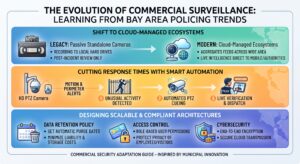
Historically, commercial security relied on passive, standalone cameras recording to local hard drives tucked away in a closet. Consequently, security teams often only reviewed footage after an incident occurred, which made it difficult to stop crimes in progress.
Today, cities are moving away from siloed legacy systems in favor of cloud-managed video ecosystems. These platforms aggregate feeds across wide geographic areas and can securely feed live intelligence directly to mobile devices or local authorities during an active incident.
Private facilities must adopt this exact philosophy. Transitioning to a cloud-managed architecture means your team can monitor multiple locations from a single dashboard, receive instant notifications, and share live video streams with responding law enforcement when every second counts.
Cutting Response Times with PTZ Cameras and Smart Alerts
Public Real-Time Crime Centers succeed because they reduce friction between the moment an event is detected and the moment an officer responds. This efficiency is largely driven by advanced hardware and intelligent software automation.
By integrating high-definition Pan-Tilt-Zoom cameras with automated motion analytics and perimeter tripwires, security systems stop relying on human eyes to watch dozens of static monitors all day.
-
Automated Threat Detection: Smart algorithms instantly flag unusual activity, such as loitering after hours or unauthorized fence climbing.
-
Instant PTZ Cues: Cameras automatically pan, tilt, and zoom directly toward the source of the motion.
-
Immediate Verification: Live alerts verify whether an incident is a false alarm or a genuine threat before dispatching guards or police.
Ultimately, these automated workflows eliminate costly delays and help secure your perimeter before damage or theft occurs.
Designing Scalable, Compliant Commercial Architectures
As municipal agencies deploy these powerful networks, they face strict scrutiny regarding data retention, cybersecurity, and public privacy guidelines. Private commercial campuses face similar compliance challenges, especially when camera fields of view spill over onto public sidewalks or neighboring properties.
When designing a scalable commercial video architecture, you must balance robust security with regulatory compliance:
-
Clear Data Retention Policies: Configure your cloud storage to automatically purge non-incident footage after a set number of days to minimize liability and storage costs.
-
Role-Based Access Control: Restrict live and recorded video access strictly to authorized personnel to protect employee and visitor privacy.
-
End-to-End Encryption: Ensure all video streams—both in transit to the cloud and at rest—are heavily encrypted to prevent unauthorized interception.
Elevating Your Campus Security Strategy
Bay Area policing is evolving rapidly through the power of connected technology and real-time intelligence. By modernizing your commercial security infrastructure with cloud-managed ecosystems, intelligent perimeter alerts, and compliant architectures, you can protect your assets just as effectively as modern municipalities protect their streets.